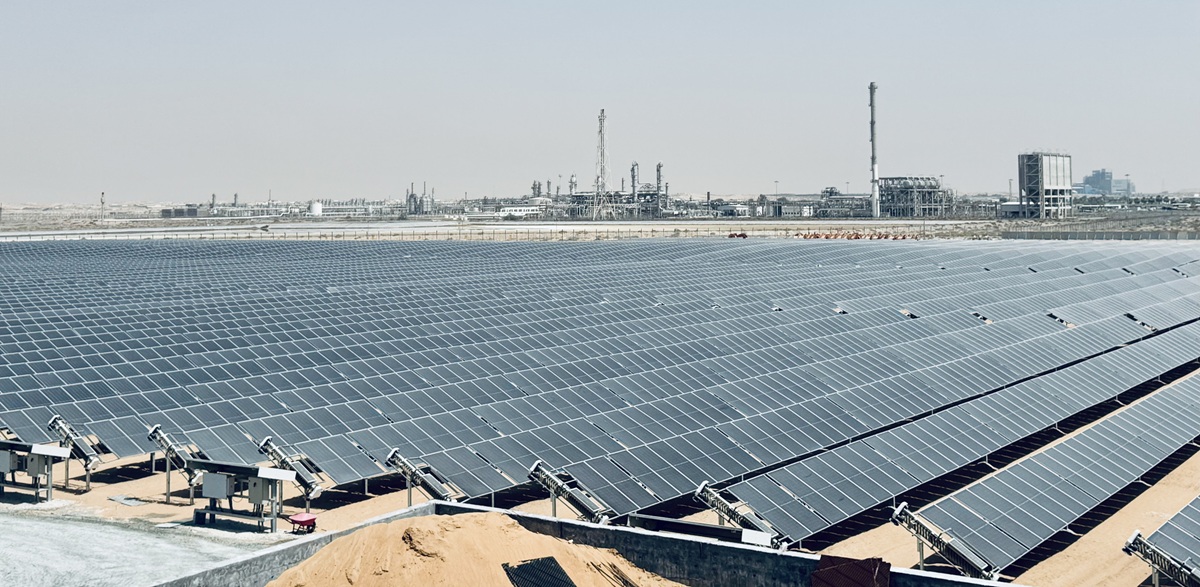
A new Ras Al Khaimah solar factory has come online at the Ras Al Khaimah Economic Zone, giving the emirate one of the largest photovoltaic manufacturing operations in the UAE. ZAKH Renewable Energy and Engineering Manufacturing has launched a 30,000-square-metre plant in the Al Ghail Industrial Zone capable of producing 600 megawatts of solar panels a year, alongside up to 500,000 square metres of building-integrated photovoltaic (BIPV) facade systems. The company describes the site as the UAE’s first full-cycle solar panel and BIPV manufacturing facility, and says it expects to scale module capacity beyond 1.8 gigawatts in the years ahead.
What ZAKH Has Built at Al Ghail
The facility pairs two things usually handled by separate suppliers. On one side is conventional solar module assembly — the familiar rooftop and solar-farm panels, produced at a rate of 600MW of nameplate capacity per year. On the other is BIPV: photovoltaic glass and cladding engineered to become part of a building’s facade rather than sit on top of it. That second line can turn out up to half a million square metres of facade material annually.
The technology runs under ZAKH’s solar brand FAERS, which began as a research programme in Azerbaijan in 2017 before moving into industrial-scale production. The panels are specified for high-temperature, high-dust desert conditions — a meaningful distinction in a market where summer rooftop heat routinely degrades output from modules designed for milder climates.
ZAKH has said it plans to serve customers across the UAE, the wider GCC and MENA region, with export ambitions reaching into Africa, Europe and the United States. Siting the plant at Al Ghail places it on the industrial, inland side of the emirate, where heavy manufacturing tenants sit alongside logistics corridors and port access — a long way, geographically and commercially, from the beach resorts most visitors picture when they think of RAK.
Why It Matters for Ras Al Khaimah
The opening lands in the middle of a notable run of industrial announcements for the emirate. RAKEZ has been steadily adding manufacturing tenants across cement, steel pipe, chemicals and now renewable energy hardware, and the free zone passed the 50,000-company mark earlier this year. Each of these plants does the same quiet work: it broadens the tax base, adds skilled jobs, and reduces how much the emirate’s fortunes ride on any single sector.
That balance matters more than it might appear. Ras Al Khaimah is in the middle of an enormous hospitality and real-estate build-out, with a hotel pipeline running past 20 properties and tens of thousands of homes due before 2030. An economy that is only tourism and property is a fragile one. Manufacturing capacity of this kind gives the emirate a second engine that keeps turning regardless of what happens to visitor numbers in any given quarter.
There is also a direct construction angle. BIPV facades are exactly the sort of product the emirate’s own developers will be specifying over the next decade, particularly on the towers going up around Al Marjan Island. Having a supplier producing that material inside the emirate shortens lead times and cuts shipping costs on projects that currently import most of their facade systems.
What This Means for Visitors and Residents
Nobody is going to book a holiday around a solar factory. But the story is a useful corrective to the postcard version of the emirate. Visitors who come for things to do in Ras Al Khaimah — the beaches, the dhow harbours, the zipline on Jebel Jais — are seeing one face of a place that is also quietly becoming an industrial exporter.
For residents and anyone weighing a move here, the practical read is about stability. A deeper industrial base tends to mean steadier employment, more year-round demand for housing outside the tourist districts, and less of the seasonal swing that makes life in a purely resort-driven economy unpredictable. It also feeds into the emirate’s sustainability positioning: locally made panels supplying local projects is a genuinely shorter carbon chain than importing modules from East Asia.
And for investors looking at Ras Al Khaimah property, the industrial corridor is worth keeping an eye on. Areas like Al Ghail sit well away from the coastal launches that dominate the headlines, but employment growth inland has a way of showing up later in rental demand across the emirate’s residential areas. Our travel advice section has more on getting around the emirate if you are planning a visit.
Source: TradeArabia