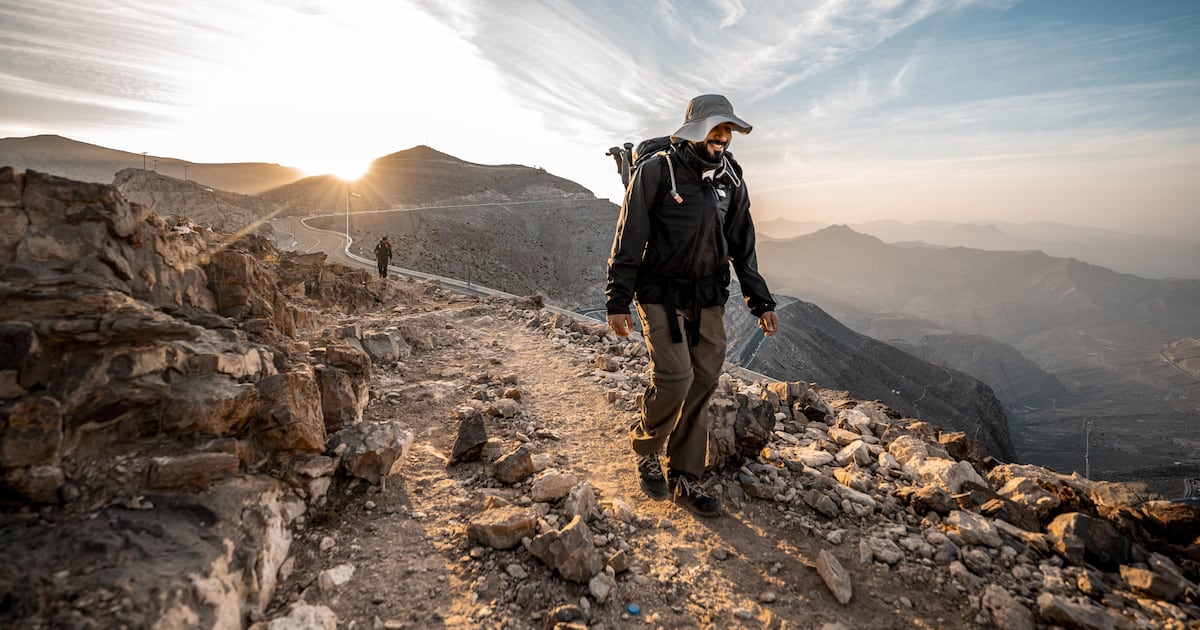
Ras Al Khaimah is preparing to turn its mountains into a multi-day destination. The Jebel Jais Grand Loop, an 80km circular mountain route, will connect existing paths on the UAE’s highest peak into a single long-distance journey designed for hiking, climbing, camping and cycling. Master developer Marjan, which is overseeing the programme, says construction on the Grand Loop is due to begin in January. Running alongside it is a separate five-day Via Ferrata climbing route of around 20km across the cliffs of northern Ras Al Khaimah – together, the biggest expansion of the emirate’s trail network so far.
An 80km loop and a five-day climb
The Grand Loop is the headline project. Rather than building an isolated new path, Marjan is stitching together the interconnected trail system that already exists on Jebel Jais, adding fresh connecting sections so walkers can stay on the mountain for several days instead of driving up for a single excursion. The route is intended to work for more than one kind of visitor: hikers, cyclists, campers and climbers all feature in the brief.
The Via Ferrata is the more technical half of the plan. Spanning roughly 20km and divided into four sections of varying difficulty, it will be supported by a network of mountain shelters reachable only on foot. Marjan has cited the Via Delle Bocchette in Italy’s Brenta Dolomites as the inspiration – one of the best-known protected climbing routes in the Alps, and a clear signal of the standard the emirate is aiming at. A shorter Via Ferrata already operates on Jebel Jais; this new route is a far longer, multi-day proposition.
Work is not limited to the marquee routes. Trail rehabilitation is already under way on the Wadi Khammed to Hidden Oasis path, with widths, gradients and rock crossings being improved and new connecting trails added. Direction signage is going in across the network, and Marjan says it will introduce international standards for trail markings so hikers can judge difficulty and suitability before setting off. Mountain rescue support will be available across the network to assist the emergency authorities. Improvements are expected to continue through the 2026-27 season, though no completion date has been given for the Grand Loop or the Via Ferrata.
Protecting the mountain while opening it up
The programme is underpinned by a biodiversity assessment carried out by Ajaz Environment Consultants, which recorded 45 plant species, 29 bird species and eight mammal species in the Jebel Jais area. Among them are the Arabian red fox, the Afro-Asiatic wildcat, Brandt’s hedgehog and the Arabian spiny mouse. Those findings are guiding where trails go, which habitats are protected and how the area will be monitored over time, and will serve as a baseline for future surveys.
“The Grand Loop and Via Ferrata give people the ability to experience it over a longer journey, but getting the fundamentals right is just as important,” said Donald Bremner, chief executive of Marjan Lifestyle. Not everyone is entirely relaxed about the scale of it. Mountaineering coach Faisal Shalmani welcomed the routes but warned that heavy construction – moving rocks, cementing steps, installing metal railings – can disrupt fragile mountain ecosystems, and suggested some form of screening or regulation for hikers to keep foot traffic from accelerating environmental damage.
For the wider emirate, the logic is straightforward. Adventure tourism is one of the few things Ras Al Khaimah offers that neighbouring emirates cannot match, and the mountains anchor a positioning built on nature rather than malls. The trail work sits alongside a broader push that includes the emirate’s expanding hotel pipeline and its target of 3.5 million annual visitors by 2030. Shalmani also made the economic case plainly: new trails benefit nearby hotels, cafes and restaurants, and create work for licensed guides.
What this means for visitors
In the short term, the Jebel Jais Grand Loop changes little for visitors. The existing Jebel Jais attractions – the zipline, the viewing deck, the established day hikes – carry on as normal, and our Jebel Jais guide covers what is open today. What shifts over the next two seasons is the type of trip the mountain supports. A destination you currently visit for an afternoon becomes one you can book three to five days around, which changes the accommodation question too: expect more demand for hotels near Jebel Jais and mountain-side stays rather than beach resorts an hour away.
Experienced hikers are the obvious early audience. One UAE resident quoted in the reporting described the multi-day routes as “much needed” after years of repeating the same existing trails, and pointed to their value as training for bigger expeditions. Casual walkers should not expect a gentle introduction: a 20km Via Ferrata with sections of varying difficulty and foot-access-only shelters is a serious undertaking, and the promised international grading system will matter.
If you are planning ahead, the practical advice is to watch for the route map Marjan is finalising, which will show every new and temporary sign across the mountain, and to plan for the cooler months. Our Jebel Jais area guide has the seasonal detail, and RAK travel advice covers getting there and what to bring.
Source: The National