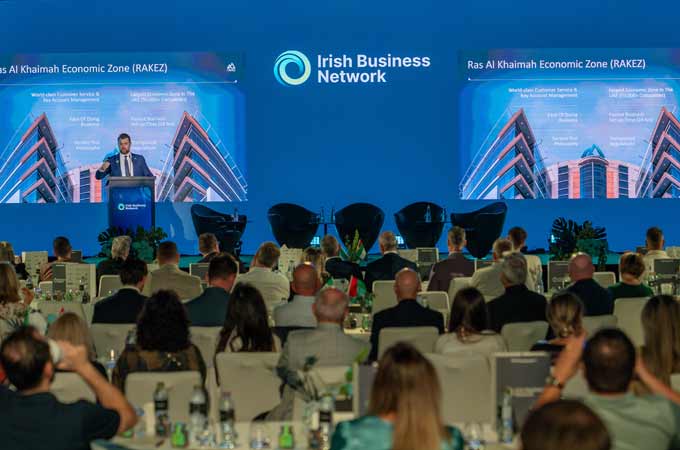
RAKEZ Irish businesses took centre stage in Dubai this week as Ras Al Khaimah Economic Zone used the Irish Business Network Dubai’s annual ‘Rise & Thrive’ seminar to position the emirate as a launchpad for Irish companies expanding into the UAE, the wider GCC and beyond. RAKEZ joined the event’s featured panel, ‘The UAE Advantage’, and backed the seminar as a gold sponsor — a sign of how deliberately the free zone is now courting specific national business communities.
The Pitch to Irish Companies
Speaking to an audience of senior Irish and Ireland-affiliated executives, entrepreneurs and government representatives, the RAKEZ team set out the emirate’s case: economic stability, a competitive operating environment and an investment pipeline that keeps widening. The argument for Irish firms in particular is about reach — using Ras Al Khaimah as a cost-efficient base from which to serve Gulf, South Asian and East African markets without carrying Dubai-level overheads.
Ireland already has a meaningful footprint in the emirate. More than 250 Irish-linked companies form part of RAKEZ’s community of over 50,000 businesses drawn from close to 200 countries. Two examples were singled out as proof the model works over the long term: Kelly Steel, which has grown its Ras Al Khaimah operation into a substantial manufacturing business, and E+I Engineering, which established PowerBar Gulf in the emirate before the business became part of global infrastructure company Vertiv.
That second case is the more interesting one commercially. A company setting up in a free zone and eventually being absorbed into a multinational is exactly the exit story free zones like to tell prospective tenants, and it lands harder with a room of founders than any brochure statistic.
Part of a Wider Market-by-Market Strategy
The Irish seminar is not an isolated outing. RAKEZ has spent 2026 running targeted roadshows and seminars across individual markets rather than relying on broad regional advertising, from multi-city tours in India to a heavy presence at AIM Congress in Dubai. A Ras Al Khaimah delegation is also touring five US cities through late September and early October.
The approach reflects where the zone sits in its growth curve. RAKEZ has averaged 28 per cent annual growth in client numbers since 2021 and occupancy across its zones now sits at around 90 per cent, which shifts the emphasis from raw volume towards attracting the right kind of tenant — manufacturers, technology firms and service businesses that anchor for years rather than months.
Ras Al Khaimah’s broader offer supports that: 100 per cent foreign ownership, zero income tax, low corporate tax, direct access to Saqr Port, and a diversified economy in which no single sector accounts for more than 27 per cent of GDP. Across the emirate as a whole, more than 73,000 companies are now registered.
What It Means for the Emirate’s Travel and Lifestyle Scene
More international business communities put down roots, and the everyday texture of the emirate changes with them. Ras Al Khaimah’s population of roughly 400,000 already spans more than 150 nationalities, and each cluster of expatriate residents tends to bring its own restaurants, sports clubs, schools and events — the connective tissue that turns a business destination into a liveable one.
Irish and European residents in the northern emirates have historically clustered around Al Hamra and Mina Al Arab, both of which have expanded their dining, marina and beach club offerings considerably over the past few years. Our areas guide breaks down how each neighbourhood feels for visitors and residents alike.
There is a direct travel dimension too. A larger Irish corporate presence strengthens the commercial case for better connectivity between Ireland and the northern emirates, whether through additional direct services into Ras Al Khaimah International Airport or improved transfer arrangements from Dubai.
What This Means for Visitors
For travellers arriving from Europe, the practical picture is unchanged for now: fly into Ras Al Khaimah International Airport where a direct route exists, or into Dubai and transfer north by road in roughly 45 to 75 minutes. Our Dubai to Ras Al Khaimah guide covers the car hire, bus and private transfer options with current costs.
For business visitors weighing a longer stay, the emirate’s hotel stock is expanding fast ahead of the Wynn opening, with new properties opening across Al Marjan Island and RAK Central. The RAK hotels section tracks what is open now, and the travel advice pages cover visas, alcohol rules, currency and the practical details worth knowing before a first trip.
Source: TradeArabia