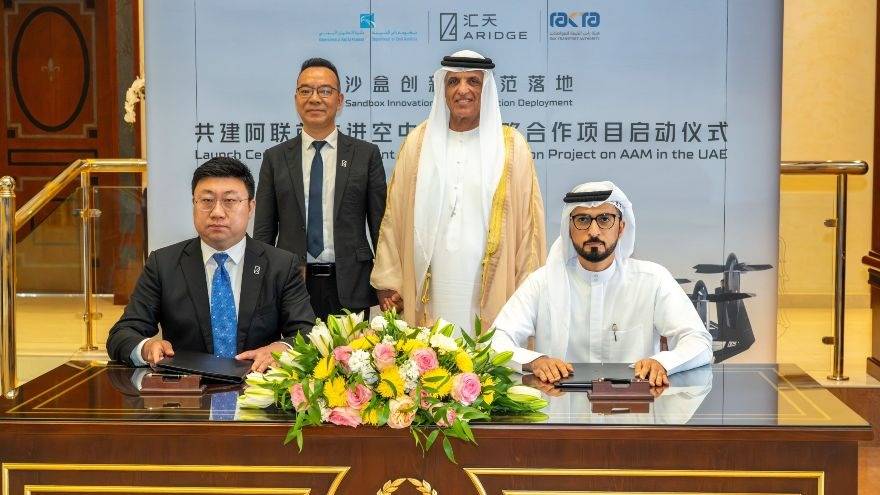
Ras Al Khaimah air mobility took a decisive step forward this week as the emirate signed a cooperation agreement to build its first dedicated test zone for flying vehicles. His Highness Sheikh Saud bin Saqr Al Qasimi, Supreme Council Member and Ruler of Ras Al Khaimah, witnessed the signing on 18 September 2026 between the Ras Al Khaimah Transport Authority, the RAK Department of Civil Aviation and Aridge, a Chinese advanced air mobility company affiliated with XPeng. The deal moves the emirate from one-off demonstration flights towards a regulated programme of validation and operational trials.
What Was Signed, and by Whom
The agreement was inked at the Ruler’s palace in Saqr bin Mohammed City during Sheikh Saud’s reception of Zhao Deli, Founder and Chairman of XPeng Aeroht, and his delegation. Eng. Ismail Hassan Al-Balushi, Director-General of the Ras Al Khaimah Transport Authority and Acting Director-General of the RAK Department of Civil Aviation, signed on behalf of the two government bodies. Dr Han Jweishian, Chief Representative for the Middle East at Aridge, signed for the company.
Under its terms, Aridge becomes the founding partner of the Ras Al Khaimah advanced air mobility test zone and the first operator to establish a physical presence in the emirate, allocating both aircraft and a specialist team to work on the ground. That distinction matters: previous activity in the UAE has largely involved visiting demonstration teams, whereas this arrangement commits hardware and engineers to Ras Al Khaimah on an ongoing basis.
The test zone is designed as a regulated environment where electric vertical take-off and landing aircraft can be assessed for readiness, and where airspace requirements, operational procedures and safety standards can be validated through phased tests and demonstrations. Progression from technology validation to operational trials will be coordinated with the RAK Department of Civil Aviation and other regulators.
Building on the 2025 Flying Vehicle Test
The partnership is not starting from scratch. Ras Al Khaimah hosted the UAE’s third emirate-level flying vehicle test flight with XPeng Aeroht in 2025, following earlier demonstrations in Dubai and Abu Dhabi. The new agreement widens that relationship from a single flight into an ecosystem, adding regulatory engagement, a permanent operating base and a longer testing runway.
Sheikh Saud framed the deal in terms of practical outcomes rather than spectacle. “We believe that the true value of technology lies in its impact on people’s lives and its ability to support development and improve services,” he said, adding that the emirate wants new technologies to “contribute to the growth of our economy, enhance Ras Al Khaimah’s competitiveness, and improve quality of life.”
The timing sits alongside a broader push to modernise how people move around and into the emirate. Ras Al Khaimah is already expanding its airport capacity, adding hotel keys at pace, and preparing for the arrival of Wynn Al Marjan Island in 2027 — a project that will bring a significant new wave of arrivals needing fast, comfortable connections from Dubai and Abu Dhabi.
Why It Matters for Ras Al Khaimah’s Tourism Economy
The agreement explicitly names tourism as one of the sectors where advanced air mobility could eventually be applied, alongside transport, logistics and emergency response. For an emirate whose headline attractions are spread across mountains, coastline and desert, that is more than a throwaway line. Short-hop air links could one day connect Al Marjan Island, Jebel Jais and Ras Al Khaimah International Airport in minutes rather than the hour-plus drives those journeys take today.
Emergency response is arguably the nearer-term win. Jebel Jais, the UAE’s highest peak, draws hikers, via ferrata climbers and zipline riders year-round, and rapid aerial access to remote trail sections has obvious value as the mountain’s things to do in Ras Al Khaimah portfolio keeps growing.
None of this is imminent. Every future deployment remains subject to UAE regulatory approval and the operational readiness of the aircraft themselves, and the agreement is deliberately staged rather than promising a launch date. But establishing a permanent test zone is how a destination positions itself to be early rather than late when the technology does mature.
What This Means for Visitors
In the short term, nothing changes for travellers. There is no flying taxi service to book, and no timeline has been announced for passenger operations. What visitors may notice over the coming seasons is increased test activity in designated airspace, and possibly public demonstrations of the kind the emirate has staged before.
For anyone planning a trip, the practical routes into Ras Al Khaimah remain the familiar ones: a direct flight into Ras Al Khaimah International Airport, or the roughly 45 to 75 minute drive up from Dubai. Our Dubai to Ras Al Khaimah guide covers the car, bus and transfer options, and the RAK hotels section tracks what is open now versus what is still under construction.
For investors and residents, the signal is clearer. Ras Al Khaimah is positioning itself as a place where new mobility technology can be tested under a real regulatory framework — a selling point it is now pairing with its free zone offering, its hospitality pipeline and its expanding Wynn Al Marjan development.
Source: Travels Dubai